
American Eagle, Maple Leaf, Britannia, or Krugerrand? Comparing Top 1-Ounce Gold Coins
Comparing purity (.9999 vs. .9167), gross coin weight, anti-counterfeit engraving, tax exemptions, and dealer spreads across the world's four most liquid gold coins.
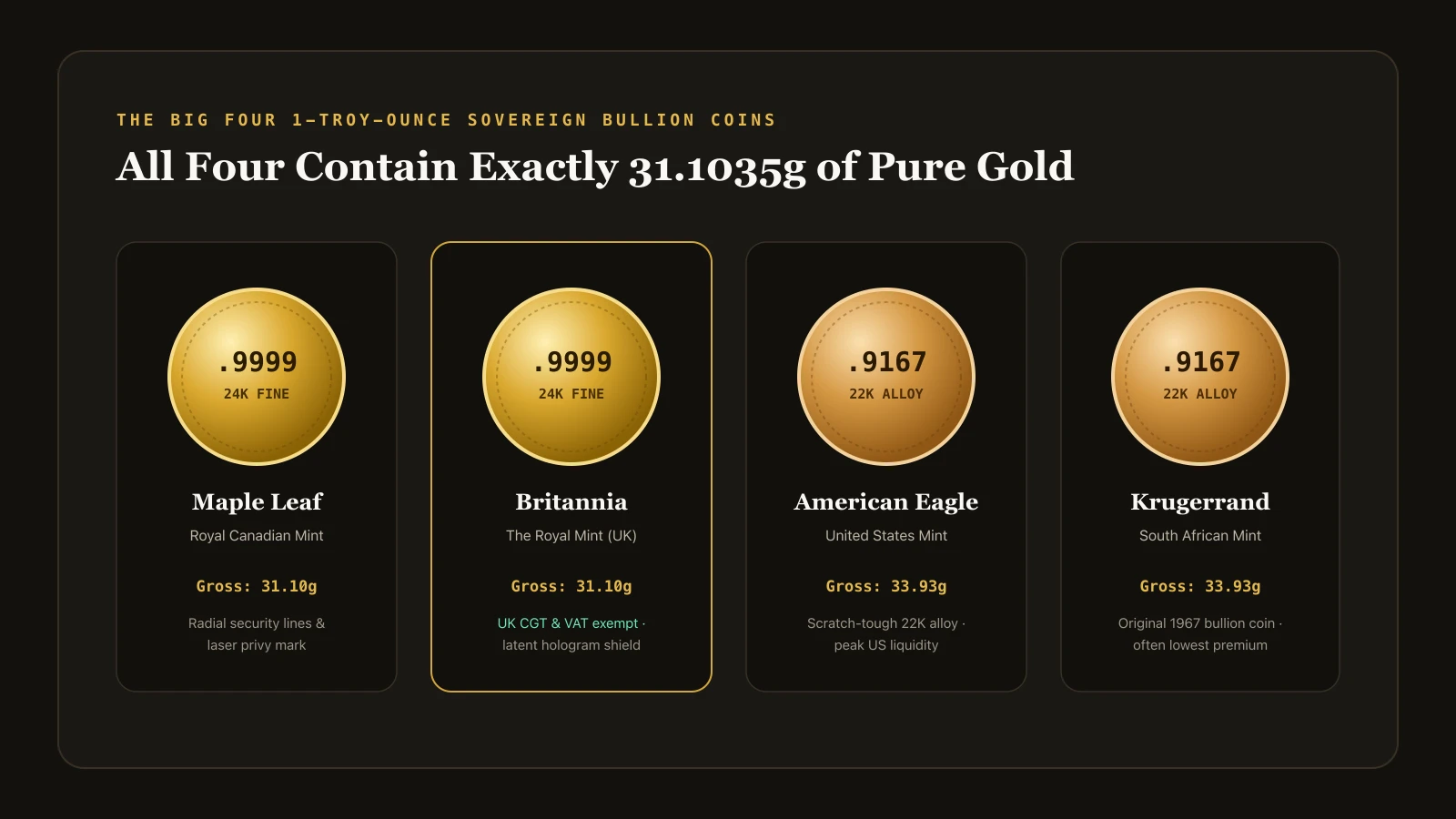
Clearing up the 24K vs. 22K sovereign coin myth
Almost every new bullion buyer stares at a product spec sheet and asks the same reasonable question: 'Why does a 22K American Gold Eagle cost MORE than a 24K Canadian Maple Leaf if 22K is less pure?'
The answer surprises beginners: BOTH coins contain the exact same 1.0000 troy ounce (31.1035 grams) of pure fine gold. Rather than removing gold to make a 22K coin, the US Mint and South African Mint start with a full 31.1035 grams of pure gold and ADD 2.83 grams of copper (plus silver in the Eagle) on top, bringing the coin's gross weight to 33.93 grams. That extra alloy protects rims and faces against dings during handling without sacrificing a milligram of gold.
Canadian Gold Maple Leaf (.9999 fine 24K)
Struck by the Royal Canadian Mint since 1979, the Gold Maple Leaf is the global benchmark for ultra-pure 'four nines' (.9999) gold bullion. Modern post-2015 Maple Leafs incorporate precision radial micro-lines across the field that create a subtle light-diffracting shimmer, paired with a tiny laser-etched maple leaf privy mark showing the two-digit mint year under magnification.
Because the Royal Canadian Mint runs highly efficient high-volume minting, Maple Leafs frequently retail for 1% to 1.5% less premium than American Gold Eagles while commanding effortless global buyback liquidity across North America, Europe, and Asia.
| Coin (1 oz Fine Gold) | Fineness | Gross Weight | Key Security / Tax Edge | Typical Premium |
|---|---|---|---|---|
| Canadian Maple Leaf | .9999 (24K) | 31.1035 g | Radial lines + laser privy mark | +3.0% to +4.5% |
| UK Gold Britannia | .9999 (24K) | 31.1035 g | Latent hologram + UK CGT exempt | +3.0% to +4.5% |
| American Gold Eagle | .9167 (22K) | 33.9305 g | Tough 22K alloy + peak US liquidity | +4.0% to +6.0% |
| South African Krugerrand | .9167 (22K) | 33.9305 g | Scratch-resistant + lowest spread | +2.5% to +4.0% |
UK Gold Britannia (.9999 fine 24K)
The Royal Mint's Gold Britannia arguably packs the strongest suite of visual anti-counterfeit defenses of any modern bullion coin: a latent security disc that flips between a padlock and a trident as you tilt the coin, animated surface waves in the background, crisp micro-engraved Latin border text, and tincture lines inside Britannia's shield.
For UK residents, Britannias (alongside traditional 22K Gold Sovereigns) carry a massive legal advantage: because they are UK legal tender, they are both VAT-free on purchase AND 100% exempt from UK Capital Gains Tax when sold — regardless of how much profit you make.
American Gold Eagle & South African Krugerrand (.9167 fine 22K)
The American Gold Eagle (22K — 91.67% gold, 3% silver, 5.33% copper) is the undisputed liquidity king inside the United States. Every US coin shop knows it by sight and sound, and it qualifies cleanly for US precious-metals IRAs. Its one drawback is slightly higher retail premiums during peak demand.
The South African Krugerrand (22K — 91.67% gold, 8.33% copper), launched in 1967, invented the modern private bullion coin market. Its rich coppery-orange hue is unmistakable, it shrugs off scratches effortlessly, and it frequently trades at the lowest upfront premium of all four iconic 1-ounce coins.
Worked Real-World Math
Why Lower Upfront Premiums Compound When Building a 5-Coin Stack
Spot gold sits at $3,540/oz. Compare buying five 1-ounce coins at +3.2% premium (Britannia/Maple/Krugerrand) vs. +5.5% premium (peak-demand Eagle).
- 1.Five coins at +3.2% premium: 5 × $3,653.28 = $18,266.40 total cost.
- 2.Five coins at +5.5% premium: 5 × $3,734.70 = $18,673.50 total cost.
- 3.Difference in upfront cash for the exact same 5.000 troy ounces of pure gold = $407.10 saved immediately.
Bottom line: Unless local tax laws specifically favor a domestic coin (such as UK Britannias), choosing the lowest-premium sovereign coin among the Big Four improves your break-even point on day one.
Before You Act
Sovereign Gold Coin Buyer's Checklist
- Keep soft .9999 24K coins (Maple Leafs, Britannias, Buffaloes) inside clear protective capsules or mint tubes.
- Check local tax advantages first — UK buyers almost always benefit most from Royal Mint Britannias or Sovereigns.
- Compare live buy AND buyback quotes at your chosen dealer to measure the true round-trip spread.
- Stick to standard bullion strikes rather than overpriced 'proof' or graded collector slabs unless you actively collect numismatics.
Put This Into Practice
Check live 1-troy-ounce gold value in your currency
Quick Answers
Frequently Asked Questions
Do 24K gold coins scratch more easily than 22K coins?
Yes — pure .9999 fine coins like Maple Leafs, Britannias, and American Gold Buffaloes are noticeably softer and should be kept inside protective capsules rather than handled bare-handed.
Why does the American Gold Buffalo cost about the same as the American Gold Eagle?
Both are minted by the United States Mint with exactly 1.0000 troy ounce of fine gold — the Buffalo is struck in .9999 pure 24K gold (31.10g gross) while the Eagle uses durable 22K alloy (33.93g gross).
Are fractional 1/4 oz or 1/10 oz sovereign coins worth buying?
Fractional coins offer great flexibility if you want to sell smaller amounts later, but carry steeper percentage premiums (often 7%–14% vs. 3%–5% on 1 oz coins). Save for 1/2 oz or 1 oz coins when possible.
Which 1-ounce gold coin is easiest to resell worldwide while traveling?
Canadian Maple Leafs, American Eagles, UK Britannias, Austrian Philharmonics, and South African Krugerrands are universally recognized by bullion dealers across every major financial hub.
About the Author
Nadia Rahman — Quantitative Market Data & Pricing Methodology Lead
Specializes in spot-to-retail bullion conversion models, traditional South Asian and Middle Eastern weight systems, and transparent consumer pricing calculators.
Read our editorial & fact-checking standards →