Live Spot XAU
Oz: $3,668.5024K/g: $117.95

Karat & Stamp Guide

How to Know What Karat Your Gold Is

Found a tiny 750, 916, or 14KP stamp inside a ring — or trying to check an unmarked family heirloom? Decode any hallmark below, compare 24K to 9K purity, or run a safe water density check at home.

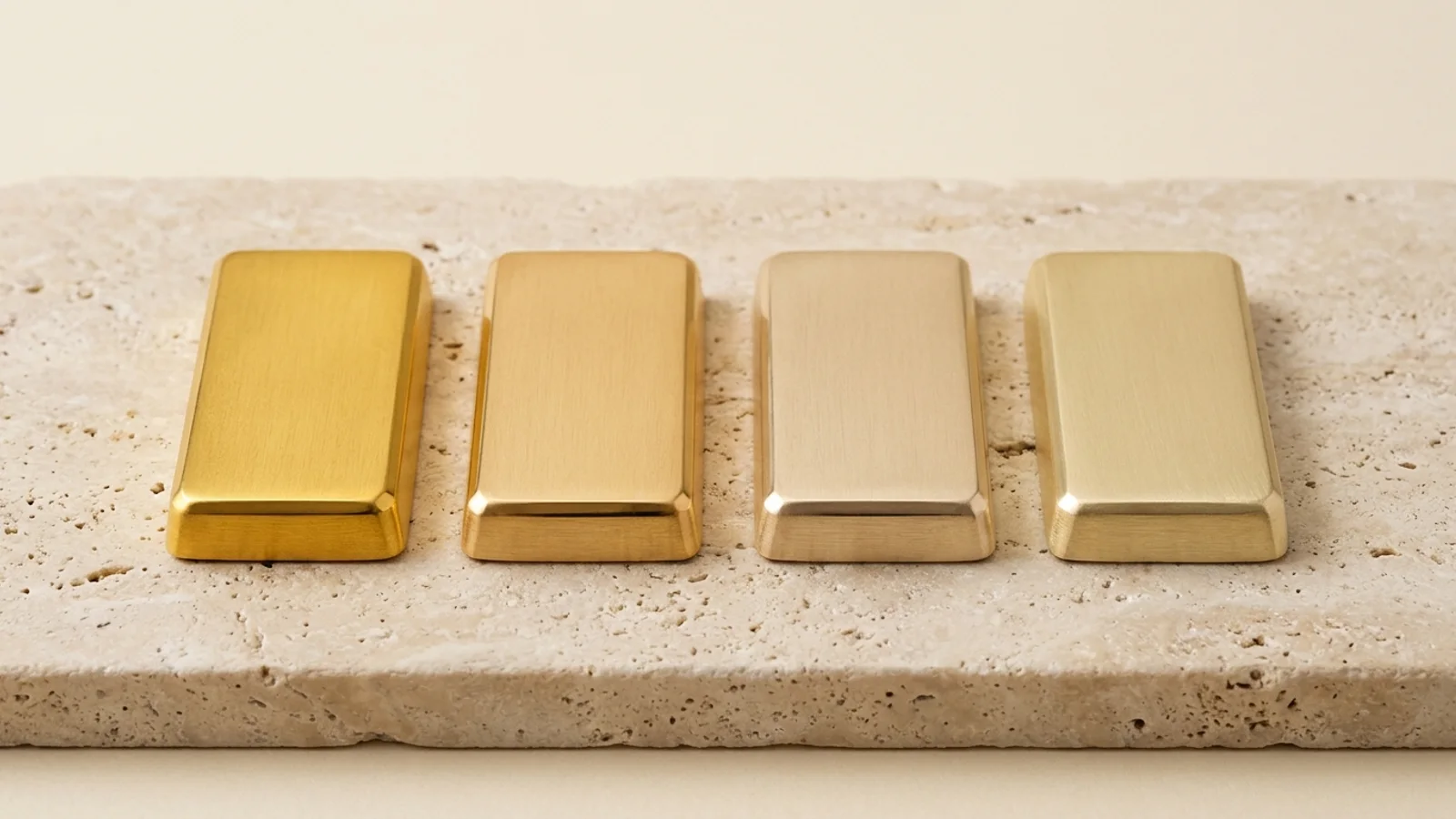
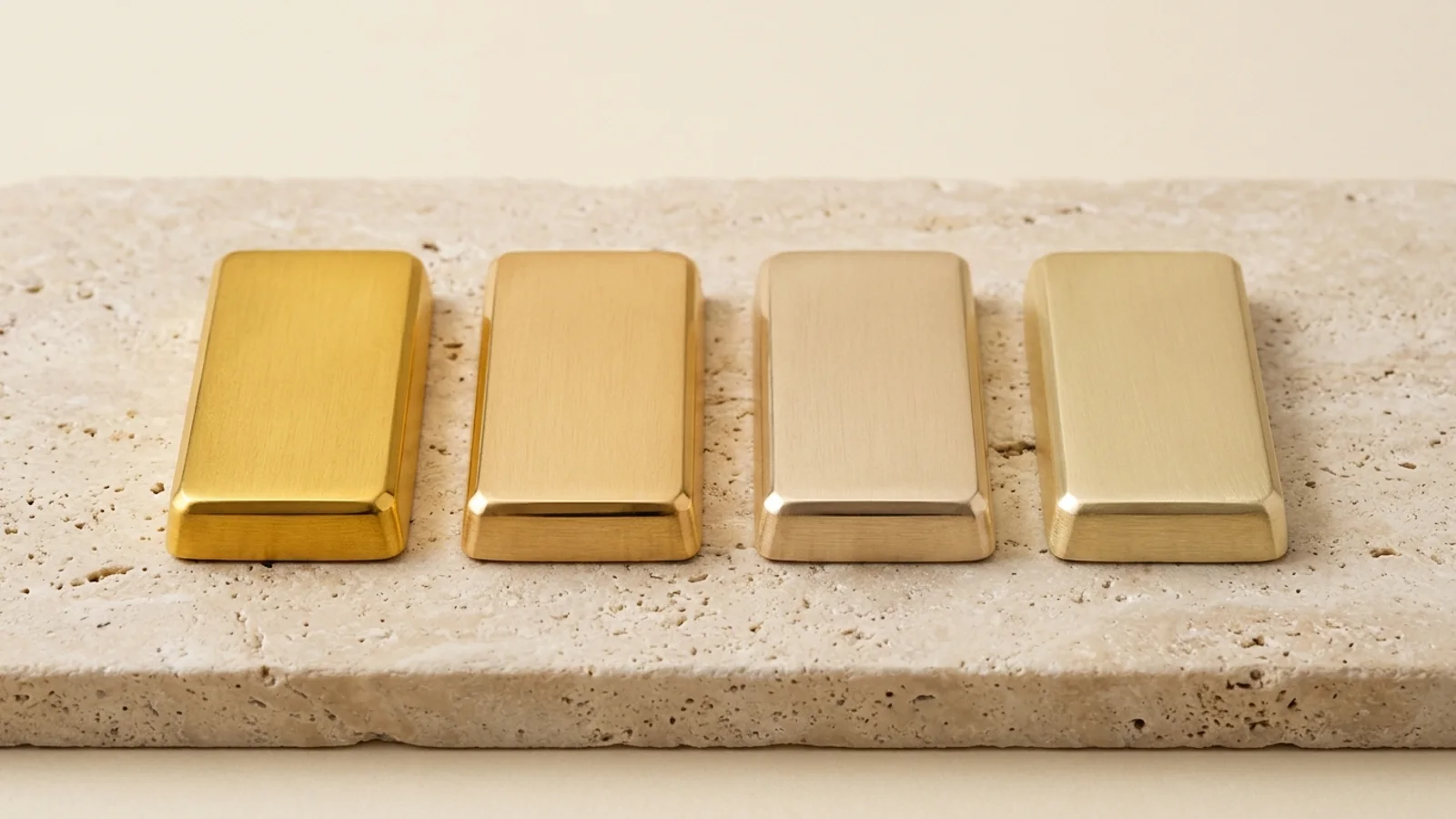
Four gold ingots illustrating natural color differences from rich 24K pure yellow gold down to 22K, 18K, and 14K

1. Gold Hallmark & Stamp Decoder

999 / 999.9

Solid Gold
24K Pure Gold· 99.9% pure gold

Contains 99.9% ('three nines') or 99.99% ('four nines') pure gold. Used for Swiss bullion bars, Canadian Maple Leafs, American Buffaloes, and pure Asian heritage ornaments. Very soft and bends easily.

Common origin: Global Bullion Standard

995

Solid Gold
24K Bullion Grade· 99.5% pure gold

Minimum purity accepted for LBMA London Good Delivery 400 oz bars and VAT-exempt investment gold across the EU, UK, Australia, and Singapore.

Common origin: LBMA Good Delivery / Institutional

916

Solid Gold
22K Solid Gold· 91.67% pure gold

22 parts pure gold out of 24 (91.67%), alloyed with 8.33% copper, silver, or zinc for structural strength. The dominant bridal and heirloom jewelry standard across South Asia and the Gulf.

Common origin: India, UAE, Bangladesh, Pakistan, Malaysia, UK

875

Solid Gold
21K Solid Gold· 87.5% pure gold

87.5% pure gold. Offers rich saturated yellow luster while holding slightly firmer shape than 22K for wider bangles and detailed filigree settings.

Common origin: Saudi Arabia, Gulf States, Egypt, Bangladesh

750

Solid Gold
18K Solid Gold· 75% pure gold

Exactly 75% pure gold and 25% alloy metals. Preferred by Swiss watchmakers and luxury jewelers because prongs stay strong enough to hold diamonds securely without losing warm gold color.

Common origin: Europe, Italy, Switzerland, France, Global Luxury

585

Solid Gold
14K Solid Gold· 58.33% pure gold

58.33% pure gold (rounded up to 585 in European stamping; older Soviet/Eastern European pieces often show 583). The most popular balance of affordability, scratch resistance, and real gold value in North America.

Common origin: United States, Canada, Northern Europe, Russia (583)

417

Solid Gold
10K Solid Gold· 41.67% pure gold

41.67% pure gold and 58.33% alloy metals. Noticeably paler yellow and very scratch resistant, making it common for heavy everyday rings and budget chains.

Common origin: United States & Canada

375

Solid Gold
9K Solid Gold· 37.5% pure gold

37.5% pure gold. Legally recognized and assay-hallmarked in the UK and Australia, though it cannot be sold as 'gold' in the United States due to the 10K FTC floor.

Common origin: United Kingdom, Australia, New Zealand

333

Solid Gold
8K Solid Gold· 33.3% pure gold

33.3% pure gold. Commonly seen on vintage German rings and pendants. Has modest scrap melt value compared to 14K–22K.

Common origin: Germany, Denmark, Greece

KP (e.g., 14KP, 18KP)

Solid Gold
Karat Plumb — Solid Gold!

One of the most misunderstood stamps in jewelry. 'P' stands for 'Plumb', meaning exact or better karat purity with zero downward tolerance. 14KP means genuine solid 14K gold, never gold-plated.

Common origin: United States (Post-1981 Stamping Act)

GP / GEP / HGE / RGP

Plated / Filled (Not Solid)
Gold Plated / Electroplated· 0% pure gold

GP (Gold Plated), GEP (Gold Electroplated), HGE (Heavy Gold Electroplate), and RGP (Rolled Gold Plate) indicate a thin surface layer of gold over brass, copper, or steel. Minimal to zero scrap gold melt value.

Common origin: Global Fashion & Costume Jewelry

GF (e.g., 1/20 14K GF)

Plated / Filled (Not Solid)
Gold Filled (Bonded Layer)· 2.9% pure gold

1/20 14K GF means 1/20th (5%) of the item's total weight is a mechanically bonded outer layer of 14K gold over brass. Much thicker and longer-lasting than gold plating, with small recoverable scrap value.

Common origin: United States & Vintage Pocket Watches

925 / VERMEIL

Plated / Filled (Not Solid)
Sterling Silver (or Gold Vermeil)· 0% pure gold

925 always denotes Sterling Silver (92.5% silver), never solid gold. If yellow-colored, it is Gold Vermeil (at least 2.5 microns of 10K+ gold over sterling silver).

Common origin: Global Jewelry Standard

BIS HUID (6-Char Code)

Certification / Regional Mark
Indian Government Verified Gold

Mandatory since 2021 in India: consists of the BIS triangle logo, purity grade (e.g. 22K916 or 18K750), and a unique 6-character alphanumeric HUID code verifiable in the BIS Care mobile app.

Common origin: India (Bureau of Indian Standards)

2. Gold Karat Purity Chart (24K down to 9K)

Compare hallmark fineness numbers, exact pure gold percentage, physical density in g/cm³, everyday durability, and live USD per-gram spot value.

Gold Karat Purity, Fineness Stamps, Density & Live USD/Gram Values
KaratStampPure Gold %Density (g/cm³)DurabilityLive USD / g
24K99999.90%19.25–19.32Soft$117.95
22K91691.67%17.4–17.9Moderate$108.12
21K87587.50%16.8–17.3Moderate$103.20
18K75075.00%15.1–15.9Balanced$88.46
14K58558.33%12.9–14.6Durable$68.80
10K41741.67%11.3–11.7Very Hard$49.14
9K37537.50%10.9–11.4Very Hard$44.23

3. Solid Gold vs. Plated Stamps People Confuse Most

A single extra letter after a karat stamp can be the difference between solid gold and plated brass.

Solid Gold
14KP / 18KP

Solid 'Karat Plumb' gold — exact full karat purity, NOT plated.

Not Solid Gold
14K GP / 18K GEP / HGE

Thin electroplated gold film over brass or copper (~$0 gold scrap).

Solid Gold
916 / 22K

Solid 22-karat gold (91.67% pure gold) standard in India, UAE & Gulf.

Not Solid Gold
925 / S925 (Yellow)

Sterling silver (92.5% silver) coated in gold vermeil — never solid gold.

Solid Gold
585 / 583 / 14K

Solid 14-karat gold (58.33% pure gold) common in US & Europe.

Not Solid Gold
1/20 14K GF

Gold-filled brass (only 5% of total weight is a bonded 14K outer layer).

Solid Gold
750 / 18K / Eagle Head

Solid 18-karat fine gold (75% pure gold) used in luxury jewelry & watches.

Not Solid Gold
RGP / EP / PVD Gold

Rolled gold plate or vapor-coated steel fashion jewelry.

Non-Destructive Home Check (Archimedes Method)

Specific Gravity Gold Density Tester

Solid gold is unusually dense (19.32 g/cm³ for 24K versus 8.5 g/cm³ for brass). Using a 0.01g digital scale, a cup of water, and thin dental floss, you can estimate an unmarked item's karat without scratching it.

  1. 1. Weigh dry itemWeigh your clean, stone-free gold item on a 0.01g pocket scale and record its dry mass.
  2. 2. Tare a cup of waterPlace a plastic cup of room-temperature water on the scale and press Tare (0.00 g).
  3. 3. Suspend underwaterHang the piece by thin thread completely submerged without touching the cup walls or bottom. Record that reading.
Measured Specific Gravity
17.61 g/cm³
22K Gold (916) or 21K Gold (875)

Falls squarely in the 21K–22K yellow gold range (16.8–17.9 g/cm³ depending on copper vs. silver alloy ratio).

4. Five Safe Steps to Check Unmarked Gold

  1. 1

    Inspect inside surfaces for a karat or millesimal stamp

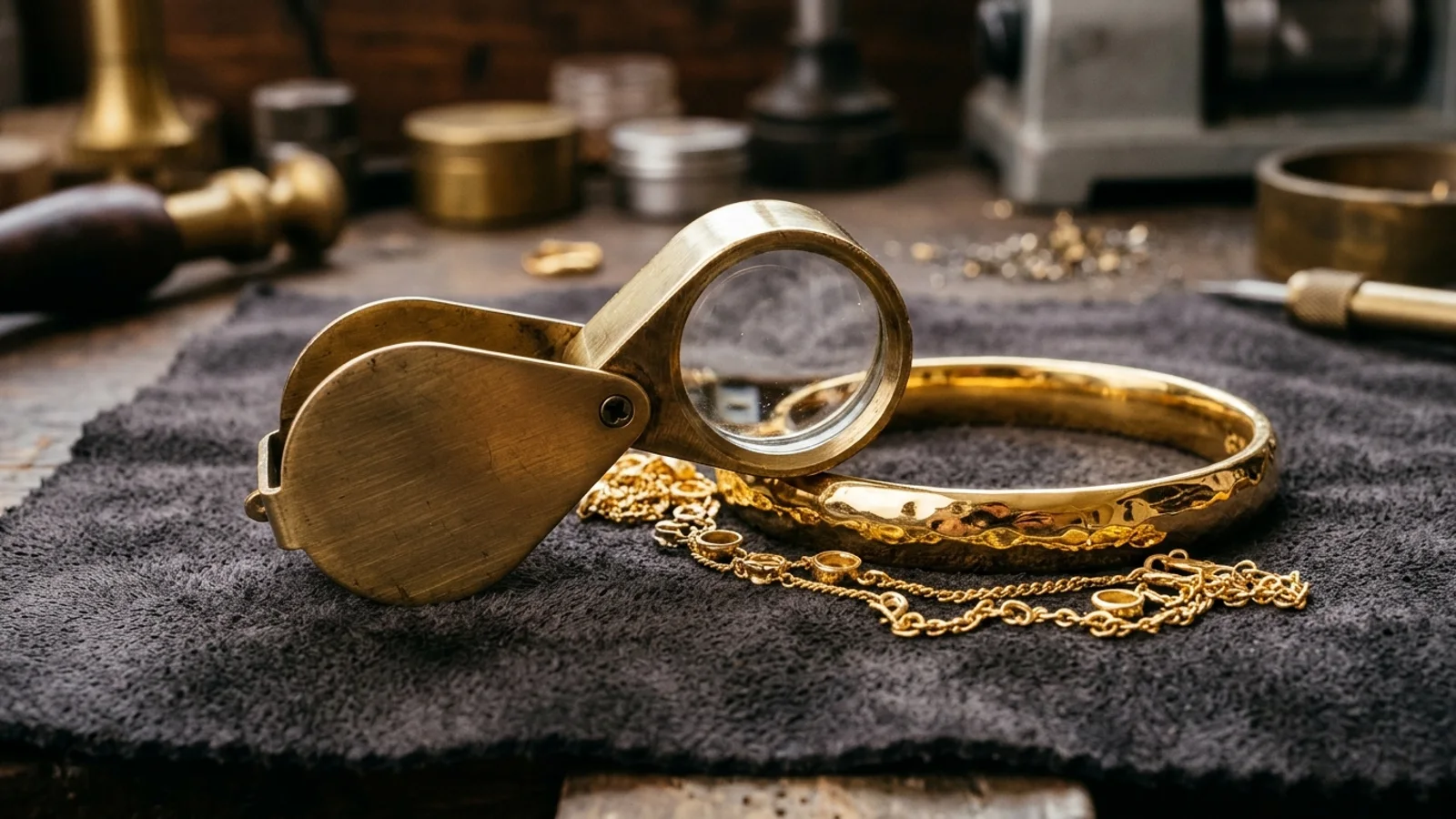
    Use a 10x jeweler's loupe or phone macro camera to inspect ring inner shanks, necklace clasps, and pendant bails for numbers like 999 (24K), 916 (22K), 875 (21K), 750 (18K), 585 (14K), 417 (10K), or 375 (9K). Watch closely for plating abbreviations such as GP, GEP, HGE, or GF.

  2. 2

    Screen with a strong neodymium magnet

    Pure gold and standard gold-silver-copper alloys are non-magnetic. If a solid chain or ring snaps strongly toward a rare-earth magnet, the core is likely iron, steel, or nickel. Note that tiny steel springs inside lobster clasps can trigger a localized pull, so test the body links separately.

  3. 3

    Measure specific gravity (Archimedes water displacement)

    For unmarked, gemstone-free solid pieces, divide dry weight in grams by submerged displacement weight in water. Solid 24K reads near 19.3 g/cm³, 22K near 17.7 g/cm³, 18K near 15.5 g/cm³, and 14K near 13.5 g/cm³, whereas plated brass sits near 8.5 g/cm³.

  4. 4

    Verify regional assay marks where applicable

    In India, verify the 6-character BIS HUID code in the BIS Care app. In the UK, look for the three compulsory Assay Office symbols. In Europe, look for the Vienna Convention scales-in-a-shield Common Control Mark.

  5. 5

    Confirm high-value pieces with non-destructive XRF testing

    Before buying or selling high-value heirloom sets or unmarked bullion bars, ask an accredited bullion dealer or assay lab for an X-Ray Fluorescence (XRF) scan, which measures exact elemental percentages in seconds without scratching or filing the metal.

Go Deeper on Gold Purity & Hallmarks

All 18 guides →

Quick Answers

Common Questions About Gold Karats & Stamps

What do 916, 750, and 585 mean stamped on gold jewelry?

Those three-digit numbers measure millesimal fineness — parts of pure gold out of 1,000. Simply divide by 10 for the percentage: 916 means 91.6% pure (22K), 750 means 75.0% pure (18K), and 585 means 58.5% pure (14K).

Does 14KP mean 14K gold plated?

No — this is one of the most common myths in jewelry. The 'P' stands for 'Plumb', meaning exact legal 14-karat solid gold with zero downward purity tolerance. Gold-plated items are stamped GP, GEP, HGE, or RGP.

Can a magnet alone tell if gold is real?

A magnet catches cheap iron or steel fakes because real gold is non-magnetic, but brass and copper fakes are also non-magnetic. Passing a magnet test is a helpful first step, never final proof by itself.

Can real gold have no stamp at all?

Yes. Handcrafted vintage jewelry, resized rings where the hallmark was cut away during soldering, and older family heirlooms from South Asia or the Middle East are often genuine 21K or 22K gold despite lacking a stamp. Use a water density check or XRF scan to confirm.

Why does 24K gold look deeper yellow than 14K gold?

Pure 24K gold has an unmistakable rich warm yellow hue. As jewelers mix in larger shares of silver, zinc, or palladium (25% in 18K, 41.7% in 14K), the yellow tint becomes softer and paler — unless extra copper is added to create rose gold.

What is the safest way to test gold without leaving a mark?

XRF (X-Ray Fluorescence) spectrometry at a reputable jeweler or bullion house is fast and completely non-destructive. At home, combining hallmark inspection, a magnet check, and the water-displacement specific gravity test gives strong screening confidence without acid scratches.