
Understanding BIS HUID Hallmarking in India: How to Verify Every 6-Digit Code
A practical buyer's guide to India's mandatory 3-mark BIS HUID system — how to inspect laser marks, verify every 6-character code in the BIS Care app, and handle older unhallmarked family gold.
Why India moved to mandatory 6-digit HUID hallmarking
For generations, Indian gold buyers faced widespread under-karating: a necklace sold as '22K' might test at 19K or 20K years later when a family tried to exchange it, silently costing households 8% to 15% of their savings. Older four-mark hallmarks improved oversight, but dishonest shops could still duplicate identical stamps without piece-level traceability.
The Bureau of Indian Standards (BIS) closed that loophole by introducing the Hallmarking Unique Identification (HUID) system. Every piece tested at an accredited Assaying and Hallmarking Centre (AHC) is now laser-etched with its own 6-character alphanumeric serial code recorded directly in the national BIS registry.
How to inspect the 3 mandatory marks at the showroom
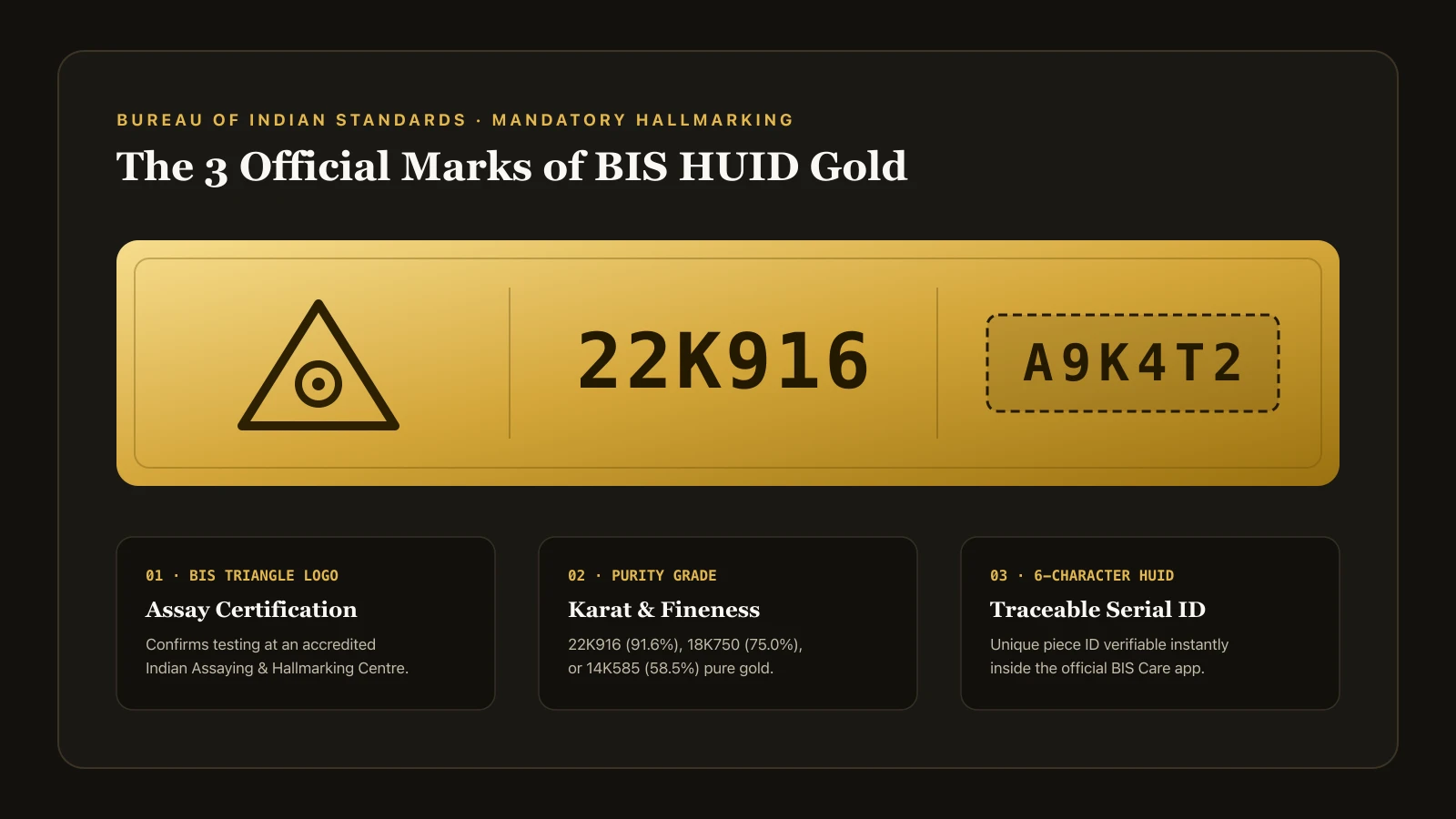
Never settle for a verbal assurance that an item is 'BIS certified' — ask the salesperson for a 10x jeweler's loupe and examine the inner surface of the bangle, ring shank, or clasp yourself. Since April 2023, only the streamlined 3-mark 6-digit HUID format is permitted for new retail sales across mandatory hallmarking districts:
Mark 1: The official triangular BIS logo. Mark 2: Karat and millesimal fineness together (such as 22K916, 18K750, or 14K585). Mark 3: The unique 6-character HUID combining letters and numbers (for example, A9K4T2).
| BIS Purity Stamp | Karat | Pure Gold % | Common Indian Retail Use |
|---|---|---|---|
| 24K999 / 24K995 | 24K | 99.9% / 99.5% | Bullion bars, sovereign & bank gold coins |
| 23K958 | 23K | 95.8% | Select ultra-high-purity regional ornaments |
| 22K916 | 22K | 91.67% | Primary Indian bridal & everyday gold jewelry |
| 20K833 | 20K | 83.3% | Regional traditional heavy jewelry |
| 18K750 | 18K | 75.0% | Diamond-studded & lightweight modern jewelry |
| 14K585 | 14K | 58.33% | Everyday office-wear & budget diamond rings |
Verifying HUID in the BIS Care app in 20 seconds
Download the official 'BIS Care' app from Google Play or the Apple App Store and tap 'Verify HUID'. Enter the 6-character code etched on your ornament. Within seconds, the app returns the registered jeweler's name, the Assaying & Hallmarking Centre name, the date of hallmarking, the exact purity grade, and the article category.
Pay close attention to the article category! One rare fraud tactic involves copying a real HUID from a tiny 2-gram nose pin onto a heavy 40-gram necklace. Confirming that the app says 'Necklace' and '22K916' closes that gap completely.
Permitted karats, exemptions, and older family jewelry
BIS authorizes hallmarking across six jewelry grades: 14K (585), 18K (750), 20K (833), 22K (916), 23K (958), and 24K (995/999 for bullion coins and bars). Lightweight items under 2 grams, watches, fountain pens, and select traditional Kundan, Polki, and Jadau jewelry currently carry statutory exemptions.
If your family owns older pre-2021 ornaments with 4-digit marks or no marks at all, do not panic — existing consumer holdings remain completely legal to wear, gift, pledge, or sell. If you ever want official certification before selling or insuring old gold, any BIS-recognized AHC will test and hallmark consumer items for a modest per-article fee.
Worked Real-World Math
Spotting What BIS HUID Protects on a 40-Gram Bridal Set
Suppose 24K spot gold in India is ₹9,600/g (22K = ₹8,800/g). Compare verified 22K916 gold against an unhallmarked piece silently under-karated to 20K.
- 1.True 22K (91.67%) pure gold inside 40g = 36.67g → Metal value = ₹3,52,000.
- 2.Under-karated 20K (83.33%) sold as '22K' = 33.33g pure gold → True value = ₹3,20,000.
- 3.Hidden loss to the buyer without BIS HUID verification = ₹32,000 (9.1%) on a single set.
- 4.Statutory BIS hallmarking fee paid to prevent that ₹32,000 loss = ~₹45 + GST per piece.
Bottom line: Spending 20 seconds checking a 6-character HUID code is the highest-return protection available to any Indian gold buyer.
Before You Act
Indian Showroom BIS HUID Verification Checklist
- Inspect all 3 marks with a loupe: BIS triangle, purity code (22K916/18K750), and 6-character HUID.
- Verify every piece's HUID in the official BIS Care app before swiping your card.
- Confirm the article type and purity in the app match the ornament in front of you.
- Ensure the GST invoice prints net gold weight, purity, HUID code, making charge, and 3% GST separately.
Put This Into Practice
Check live India 24K & 22K gold rates in INR
Quick Answers
Frequently Asked Questions
How much can a jeweler legally charge for BIS hallmarking?
The official statutory hallmarking charge is just ₹45 plus GST per article regardless of gold weight. Be wary of any showroom padding a 'certification fee' into thousands of rupees.
Are earrings under 2 grams required to have a BIS HUID?
No — lightweight ornaments weighing under 2 grams are exempt because laser-etching three legible marks onto tiny studs is technically impractical.
Does a BIS HUID guarantee the quality of diamonds set in the ring?
No. BIS HUID certifies strictly the purity of the gold metal (for example, 18K750). For diamonds, always request an independent gemological certificate (GIA, IGI, or SGL).
Can I verify gold bought in Dubai on India's BIS Care app?
No — the BIS Care registry covers strictly items assayed in India. Gold bought in Dubai is governed by Dubai Central Laboratory hallmarking instead.
About the Author
Nadia Rahman — Quantitative Market Data & Pricing Methodology Lead
Specializes in spot-to-retail bullion conversion models, traditional South Asian and Middle Eastern weight systems, and transparent consumer pricing calculators.
Read our editorial & fact-checking standards →