
UK Assay Marks and European Gold Stamps (375, 585, 750, 916): A Complete Reader
How to decode British statutory Assay Office symbols (London, Birmingham, Sheffield, Edinburgh), French Eagle Heads, Italian province lozenges, Swiss St. Bernards, and Vienna Convention marks.
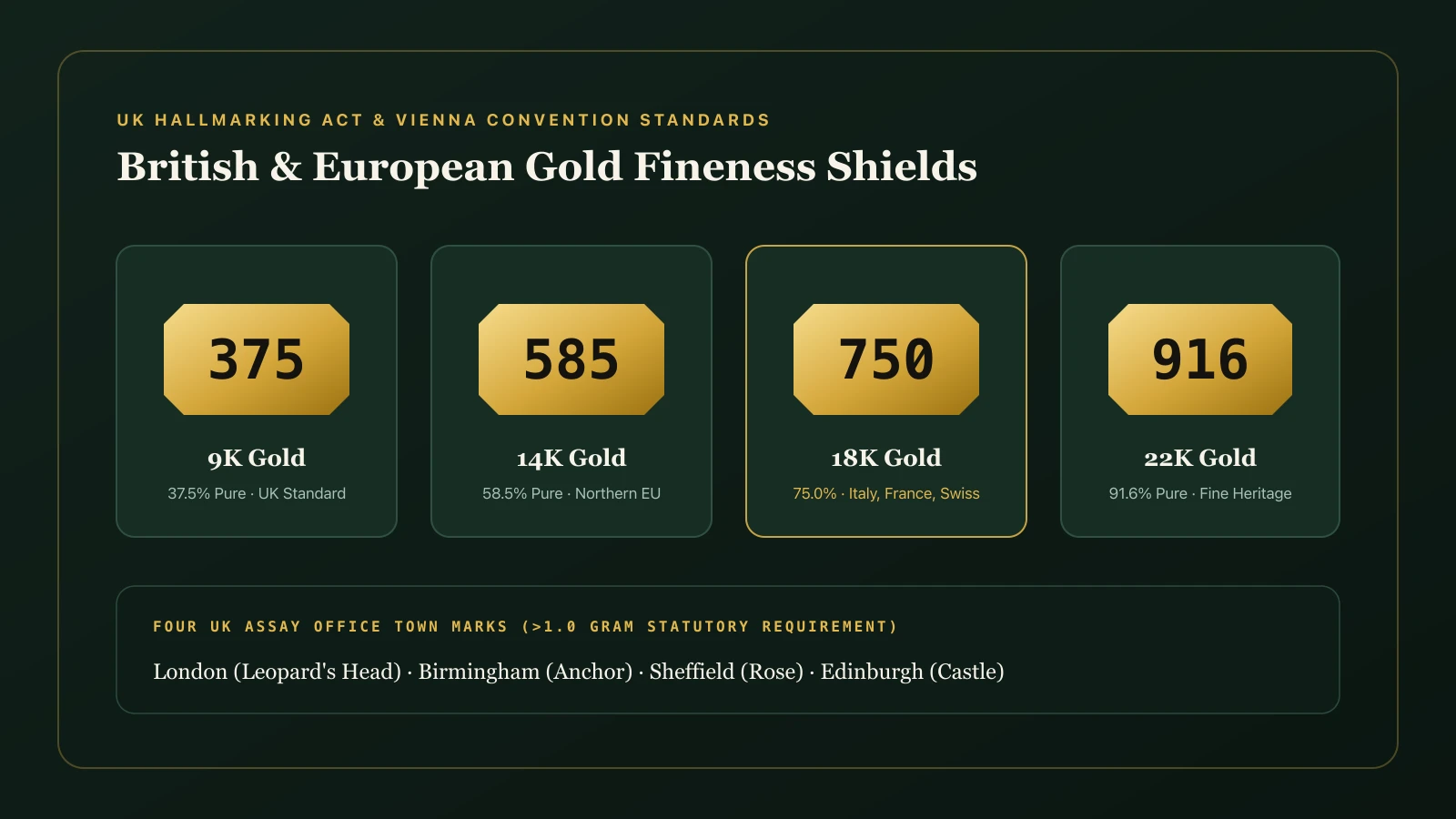
How the British statutory hallmarking system works
Britain's hallmarking law is one of the oldest continuous consumer-protection statutes in the world, originating in 1300 under King Edward I. Unlike the United States — where jewelers self-stamp karat marks under federal truth-in-labeling rules — the UK Hallmarking Act 1973 makes it illegal to describe any piece of gold over 1.0 gram as 'gold' unless an independent, government-overseen Assay Office has tested and struck it.
Every modern UK hallmark displays three compulsory punches side by side: first, the registered Sponsor's initials inside a distinctive shield; second, the millesimal fineness inside a clipped-corner rectangle (375 for 9K, 585 for 14K, 750 for 18K, 916 for 22K, or 999 for 24K); and third, the Assay Office town mark showing which laboratory tested the metal.
Recognizing the four UK Assay Office towns & date letters
The four active British Assay Offices each strike a historic heraldic emblem: London strikes a Leopard's Head, Birmingham strikes an Anchor (responsible for the highest volume of UK high-street gold), Sheffield strikes a Yorkshire Rose, and Edinburgh strikes a three-turreted Castle.
Many British rings also include two optional traditional marks: a Crown (historically denoting gold before 1999) and a stylized Date Letter inside a shield that allows antique appraisers to pinpoint the exact calendar year the piece was assayed — invaluable when authenticating Victorian or Edwardian estate gold.
| Country / Authority | Signature Symbol | Common Fineness Marks | Mandatory Independent Assay? |
|---|---|---|---|
| United Kingdom | Leopard / Anchor / Rose / Castle | 375, 585, 750, 916, 999 | Yes (>1.0 gram) |
| France | Eagle's Head (18K) / Scallop (14K) | 375, 585, 750 | Yes (>3.0 grams) |
| Switzerland | St. Bernard Dog Head | 750, 585, 999 | Yes (Watches & luxury gold) |
| Italy | Star + Number + Province Lozenge | 750 (Primary), 585, 375 | Maker registered (State ID) |
| Germany | Numeric Stamp Only | 333 (8K), 585, 750 | Maker self-regulated |
| Vienna Convention | Balance Scales over Fineness Shield | 375, 585, 750, 916, 999 | Yes (Cross-border treaty) |
Continental Europe: Italy, France, Germany, and Switzerland
Italy — Europe's powerhouse gold jewelry exporter — stamps 750 (18K) alongside a crisp polygonal lozenge containing a five-point star, the workshop's numeric registry ID, and a two-letter province code (most famously 'AR' for Arezzo, 'VI' for Vicenza, or 'AL' for Alessandria/Valenza).
France employs pictorial state assay punches: a tiny Eagle's Head ('Tête d'Aigle') certifies 18K (750) French gold, while a Scallop Shell marks 14K (585) and a Clover marks 9K (375). Switzerland stamps luxury 18K watch cases and jewelry with a St. Bernard dog head beside 750. Germany permits 333 (8K), 585 (14K), and 750 (18K) stamped directly by makers under strict legal liability.
The Vienna Convention Common Control Mark (CCM)
To allow hallmarked jewelry to move seamlessly across European borders without re-testing at every national frontier, over twenty countries (including the UK, Switzerland, Ireland, Austria, Sweden, Poland, Portugal, and Czechia) joined the Hallmarking Convention.
Look for the unmistakable Common Control Mark: a set of balance scales superimposed over the fineness number (such as 750 or 585) inside a distinctive double-scalloped shield. Seeing the CCM guarantees independent official assay testing.
Worked Real-World Math
Decoding a Vintage British Ring Stamped 'AB · 375 · Anchor · r'
You inherit a heavy 8-gram yellow gold signet ring in the UK bearing four tiny marks inside the band.
- 1.'AB' inside an oval shield = Registered Sponsor's (maker/importer) mark.
- 2.'375' inside a chamfered rectangle = 9-karat solid gold (37.5% pure gold).
- 3.Anchor symbol = Independently tested and hallmarked by the Birmingham Assay Office.
- 4.Pure gold content = 8.0g × 0.375 = 3.00 grams of fine 24K gold.
Bottom line: A complete UK hallmark confirms both independent purity verification and provenance — giving instant confidence to estate and scrap buyers alike.
Before You Act
Inspecting UK & European Gold Before Buying
- In the UK, check for all 3 statutory marks on any gold item heavier than 1.0 gram.
- On vintage Italian chains, verify both '750' and the star-plus-province lozenge ('AR' or 'VI').
- Watch out for '333' on vintage German pieces — it is solid 8K (33.3%), worth far less per gram than 18K (750).
- Look for the Vienna Convention scales-in-shield mark when shopping across Europe.
Put This Into Practice
View live UK (GBP) & Eurozone (EUR) gold rates
Quick Answers
Frequently Asked Questions
Why is 9K (375) gold so widely sold in the United Kingdom?
9K has been a legally hallmarked UK standard since 1854. Its 37.5% gold / 62.5% alloy mix resists daily dents and scratches extremely well while keeping solid hallmarked jewelry accessible.
Can I sell UK 9K (375) or German 8K (333) gold in the United States?
Yes — US scrap dealers and refiners happily buy 9K and 8K gold for their exact pure-gold melt percentage (37.5% or 33.3%), even though US retail stores cannot market items under 10K simply as gold jewelry.
What does a crown mark next to 18 mean on an old British ring?
Prior to 1999, British Assay Offices struck a traditional Crown symbol alongside the karat number (such as Crown + 18) to identify gold. Modern post-1999 hallmarks rely strictly on the 3-digit fineness shield (750).
Why is investment gold VAT-free across both the UK and European Union?
Both UK HMRC rules and EU Directive 2006/112/EC classify pure bullion bars (995+) and qualifying investment gold coins (900+) as financial instruments rather than consumer goods, exempting them from VAT.
About the Author
Daniel Hargrave — Senior Precious Metals Analyst & Managing Editor
Twelve years covering physical bullion markets, retail jewelry hallmarking standards, and retail spread analysis across London, Dubai, Mumbai, and New York.
Read our editorial & fact-checking standards →