
Making Charges, Wastage, and Buyback Deductions: A Buyer's Guide to Gold Jewelry Pricing
How jewelers calculate workmanship fees, why percentage making charges silently surge during gold rallies, and exactly how to negotiate a transparent jewelry invoice.
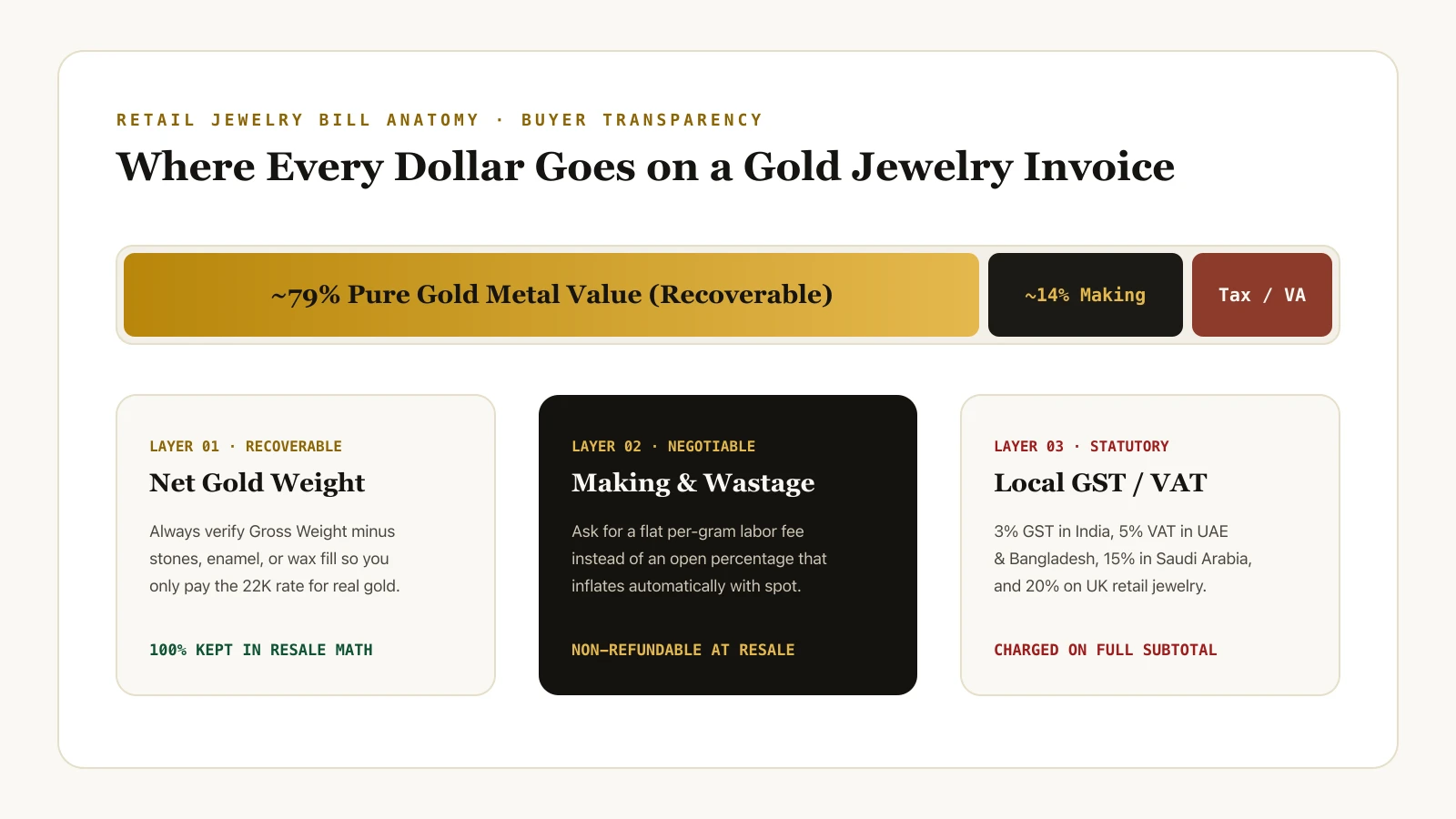
Percentage vs. flat per-gram making charges
Jewelers typically quote making charges in one of two ways: a flat fee per gram (common in Dubai, Singapore, and competitive bullion hubs) or a percentage of the day's gold value (standard across major chains in India and South Asia).
Notice the hidden catch with percentage pricing: suppose a showroom charges 14% making on a 25-gram 22K chain. When gold trades at $70 per gram, 14% equals $245 in labor. If gold climbs 50% to $105 per gram two years later, that exact same machine-made chain now carries $367.50 in making charges — a 50% raise for the exact same factory machine time.
Whenever a salesperson quotes a percentage, multiply it mentally by the day's per-gram gold rate to convert it into cash per gram. That single habit makes over-priced workmanship stand out immediately.
What 'wastage' (VA) charges really are
On traditional invoices across South Asia, buyers sometimes encounter a separate line labeled 'Wastage' or 'VA' (Value Addition) ranging from 4% to 12%. Historically, goldsmiths filed, drilled, and soldered pieces by hand, genuinely losing tiny specks of gold dust on wooden workbenches.
Modern workshops vacuum, filter, and chemically reclaim over 99% of bench dust — meaning 'wastage' today functions simply as additional profit margin. Never evaluate making charges and wastage separately; add both percentages together to judge the true combined workmanship fee.
| Jewelry Type | Typical Making Charge % | Fair Per-Gram Benchmark | Negotiation Leverage |
|---|---|---|---|
| Plain Machine Chains & Bangles | 6% – 10% | Low (Factory stamped) | High — shop 2+ stores |
| Hollow / Lightweight Daily Rings | 10% – 14% | Moderate | Moderate |
| Hand-Engraved / Filigree Sets | 14% – 20% | Elevated artisan labor | Moderate on multi-piece orders |
| Antique / Temple / Bridal Kundan | 18% – 28% | High bespoke labor | Ask for flat package cap |
The Gross Weight vs. Net Weight trap on studded jewelry
If a 22K bridal choker contains semi-precious beads, kundan glass, wax ('lac') filling, or small gemstones, confirm that the showroom weighs the gold frame strictly by Net Gold Weight — NOT Gross Weight. Paying 22K gold rates for 4 grams of glass beads or lacquer quietly adds hundreds of dollars in phantom metal charges that disappear completely on resale.
Understanding buyback & exchange deductions before you buy
Before paying at any counter, ask two direct questions and get the answers printed on the bill: 'If I exchange this hallmarked piece here in three years, what percentage of prevailing gold weight do you credit?' and 'If I sell it back for cash, what is your deduction?'
Top transparent jewelry brands credit 100% of prevailing gold-weight value on exchange (you lose only your original making charge and GST/VAT) and deduct 2%–5% on cash buyback. Unstructured local shops sometimes deduct 10%–20% ('katt') unless you negotiate clear written terms up front.
Worked Real-World Math
Spotting Hidden Cost on a 25-Gram 22K Necklace Invoice
22K gold rate is ₹8,800/g. Showroom A quotes 16% making + 3% GST. Showroom B quotes a flat ₹750/g making + 3% GST.
- 1.Pure metal value at both stores = 25g × ₹8,800 = ₹2,20,000.
- 2.Showroom A (16% making): ₹35,200 making → Subtotal ₹2,55,200 + 3% GST (₹7,656) = ₹2,62,856.
- 3.Showroom B (₹750/g flat): ₹18,750 making → Subtotal ₹2,38,750 + 3% GST (₹7,163) = ₹2,45,913.
- 4.Exact savings on the identical 25g 22K weight = ₹16,943 (6.4% cheaper total bill).
Bottom line: Negotiating making charges down from 16% to an equivalent 8.5% saves far more cash than waiting weeks for a 1% dip in spot gold.
Before You Act
Showroom Invoice Audit Checklist
- Demand an itemized bill separating Net Gold Weight, Stone Weight, Rate per Gram, Making Charge, and Tax.
- Convert percentage making charges into cash per gram so high spot prices don't disguise inflated labor fees.
- Confirm no duplicate 'Wastage' fee is stacked on top of a high making charge.
- Save your original hallmarked invoice safely — it boosts future exchange value by 5%–15%.
Put This Into Practice
Break down a real bill with our Making Charge Calculator
Quick Answers
Frequently Asked Questions
Do I ever get making charges back when I sell or exchange old gold?
No. Making charges cover fabrication labor and showroom overhead and are written off at purchase. Resale and exchange quotes value strictly the net gold weight at the prevailing rate.
Why do '0% making charge' festival ads sometimes still cost more?
Occasionally a shop waives making charges only on older slow-moving stock, or embeds a higher per-gram gold rate board than live market parity. Always check the final total bill divided by net grams.
Is 18K jewelry making charge higher than 22K?
Often yes in percentage terms, because 18K pieces frequently involve intricate stone setting and rhodium finishing — even though the underlying gold cost per gram is lower.
Can I negotiate making charges at big branded jewelry chains?
Even national chains often have manager discretion of 1%–3% off making charges on heavier bridal orders or during off-peak weekdays, especially when you politely cite a competing showroom's itemized quote.
About the Author
Daniel Hargrave — Senior Precious Metals Analyst & Managing Editor
Twelve years covering physical bullion markets, retail jewelry hallmarking standards, and retail spread analysis across London, Dubai, Mumbai, and New York.
Read our editorial & fact-checking standards →