
How to Sell Old or Broken Gold Jewelry Without Losing 30% at the Counter
A step-by-step seller's playbook: sorting by karat at home, calculating live melt math first, catching scale unit tricks, and choosing the highest-paying buyer type.
Step 1: Sort, inspect, and weigh your gold at home
The single biggest reason sellers walk out with 60 cents on the dollar is arriving unprepared. When you hand a buyer an unsorted velvet pouch full of tangled 10K, 14K, and 18K pieces without knowing what they weigh, you hand over 100% of the pricing leverage.
Spend fifteen minutes at home with a magnifying glass and a $15 0.01-gram pocket scale. Separate every item into labeled piles by stamp (22K/916, 18K/750, 14K/585, 10K/417, 9K/375, and 'Unmarked'). Remove obvious costume pieces stamped GP, GF, or 925 so you look informed and organized at the counter.
Step 2: Know the huge payout gap across buyer types
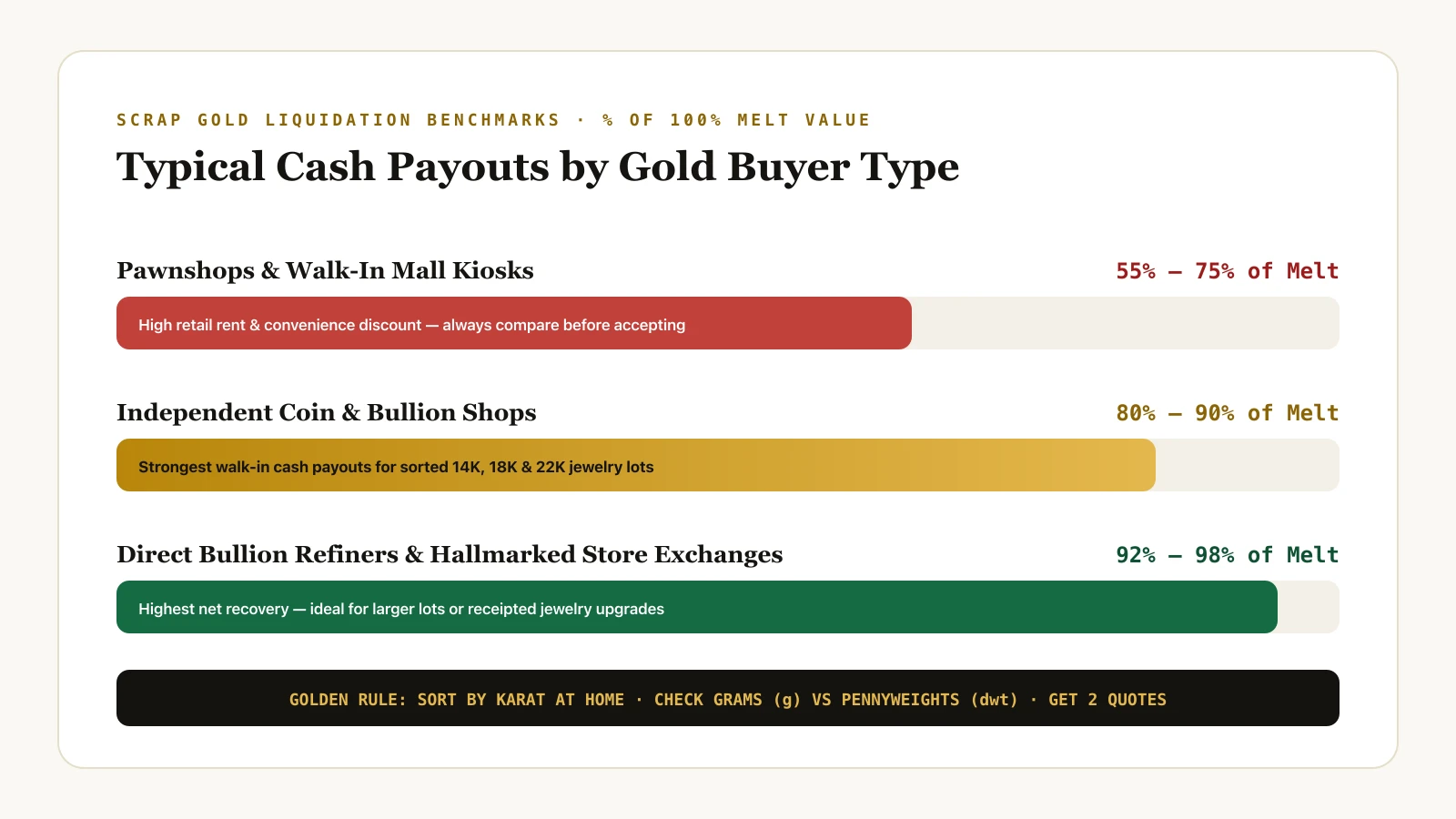
Gold buyers operate on radically different business models. Walk-in pawnshops, hotel buying roadshows, and TV mail-in envelopes spend heavily on rent and advertising; their initial cash quotes frequently start between 50% and 70% of melt value.
Established independent coin dealers, local bullion exchanges, and regional precious-metals refiners run lean operations on rapid turnover — routinely offering 82% to 92% of live melt value on clean hallmarked jewelry. On a $3,000 scrap lot, walking ten minutes from a pawnshop to a reputable coin shop can literally put an extra $600 to $800 in your pocket.
| Buyer Channel | Typical % of Melt Value | Payment Speed | Best Used For |
|---|---|---|---|
| Mall Kiosk / Mail-In Ads | 50% – 68% | Instant / Mail delay | Avoid unless zero local alternatives exist |
| Local Pawnshop | 60% – 75% | Instant cash | Short-term collateral loan only, not outright sale |
| Independent Coin / Bullion Dealer | 80% – 90% | Instant cash / wire | Best everyday walk-in cash payout |
| Direct Precious Metals Refiner | 92% – 97% | 2 – 5 business days | Larger scrap lots (50g+ pure gold) |
| Original Showroom Exchange | 95% – 100% credit | Instant toward new item | Upgrading old hallmarked jewelry |
Step 3: Three counter tactics to watch out for
Trick 1 — Mixed-pile weighing: Never allow a buyer to toss a 14K ring and a 22K bangle onto the pan together and quote an 'average 14K rate.' Demand each karat pile be weighed and priced on its own line.
Trick 2 — The Pennyweight (dwt) confusion: In North America, some buyers set scales to pennyweights (1.555 grams) while quoting a figure that sounds like a per-gram rate. Always verify the unit icon on the display.
Trick 3 — Scrapping wearable designer or gemstone jewelry: Scrap buyers pay strictly for gold metal and subtract stone weight. If you own signed luxury brands (Cartier, Tiffany, Van Cleef) or clean diamonds above 0.50 carats, visit an estate jeweler or auction specialist first.
Step 4: Cash sale vs. store credit exchange
If you plan to buy new gold jewelry anyway, check your original jeweler's exchange policy before selling for scrap cash. Major chains across India, UAE, Malaysia, and Bangladesh frequently credit 95%–100% of prevailing pure gold value toward a new purchase when you bring hallmarked pieces with the original invoice — outperforming cash scrap quotes cleanly.
Worked Real-World Math
Why Calling Two Buyers Earns $620 More on One Mixed Scrap Lot
You have 14g of 14K rings + 16g of 18K broken chains when 24K spot gold is $113.80/g.
- 1.14K pure gold = 14g × 0.5833 = 8.17g → Melt value = $929.75.
- 2.18K pure gold = 16g × 0.7500 = 12.00g → Melt value = $1,365.60.
- 3.Combined 100% Pure Melt Value = $2,295.35.
- 4.Pawnshop offer at 62% of melt = $1,423.12 vs. Coin Dealer offer at 89% of melt = $2,042.86.
Bottom line: Twenty minutes of sorting and one phone call to a local bullion dealer puts +$619.74 extra cash directly into your hand.
Before You Act
Seller's Counter-Ready Checklist
- Sort items by karat stamp and record dry gram weights at home before leaving.
- Run your lot through our Scrap Gold Calculator so you know your 100% melt ceiling.
- Bring government photo ID (legally required by precious-metals buyer laws in most jurisdictions).
- Get at least two written same-day offers — and never feel pressured to leave jewelry behind overnight.
Put This Into Practice
Estimate your exact cash payout in our Scrap Gold Calculator
Quick Answers
Frequently Asked Questions
Do broken clasps, missing stones, or bent chains reduce scrap gold payout?
Not at all. Scrap buyers melt jewelry straight back into fine bullion, so mangled chains and single mismatched earrings pay the exact same per-gram rate as flawless pieces of the same karat.
Will a buyer let me keep my diamonds or gemstones before melting a ring?
Reputable jewelers and coin shops can usually pop loose stones out of prongs for you right at the bench before weighing the remaining gold mounting — just ask beforehand.
Why can't any buyer pay 100% of spot melt value in cash?
Cash buyers incur assaying time, smelting loss, refinery fees (1%–3%), insurance, regulatory holding periods, and spot-price hedging risk while the scrap awaits refining.
Is selling old gold jewelry taxable?
Tax treatment varies by country. In the US, selling physical gold for more than your original cost basis can trigger collectibles capital gains tax; in the UK, personal chattels under £6,000 or UK sovereign coins enjoy exemptions. Consult a local tax advisor on large estate sales.
About the Author
Daniel Hargrave — Senior Precious Metals Analyst & Managing Editor
Twelve years covering physical bullion markets, retail jewelry hallmarking standards, and retail spread analysis across London, Dubai, Mumbai, and New York.
Read our editorial & fact-checking standards →