
How to Tell What Karat Your Gold Is Without Ruining It: Stamps, Density, and XRF
Skip aggressive filing and nitric acid stains — follow the five-stage non-destructive verification workflow professionals use on heirloom rings, chains, and unmarked gold.
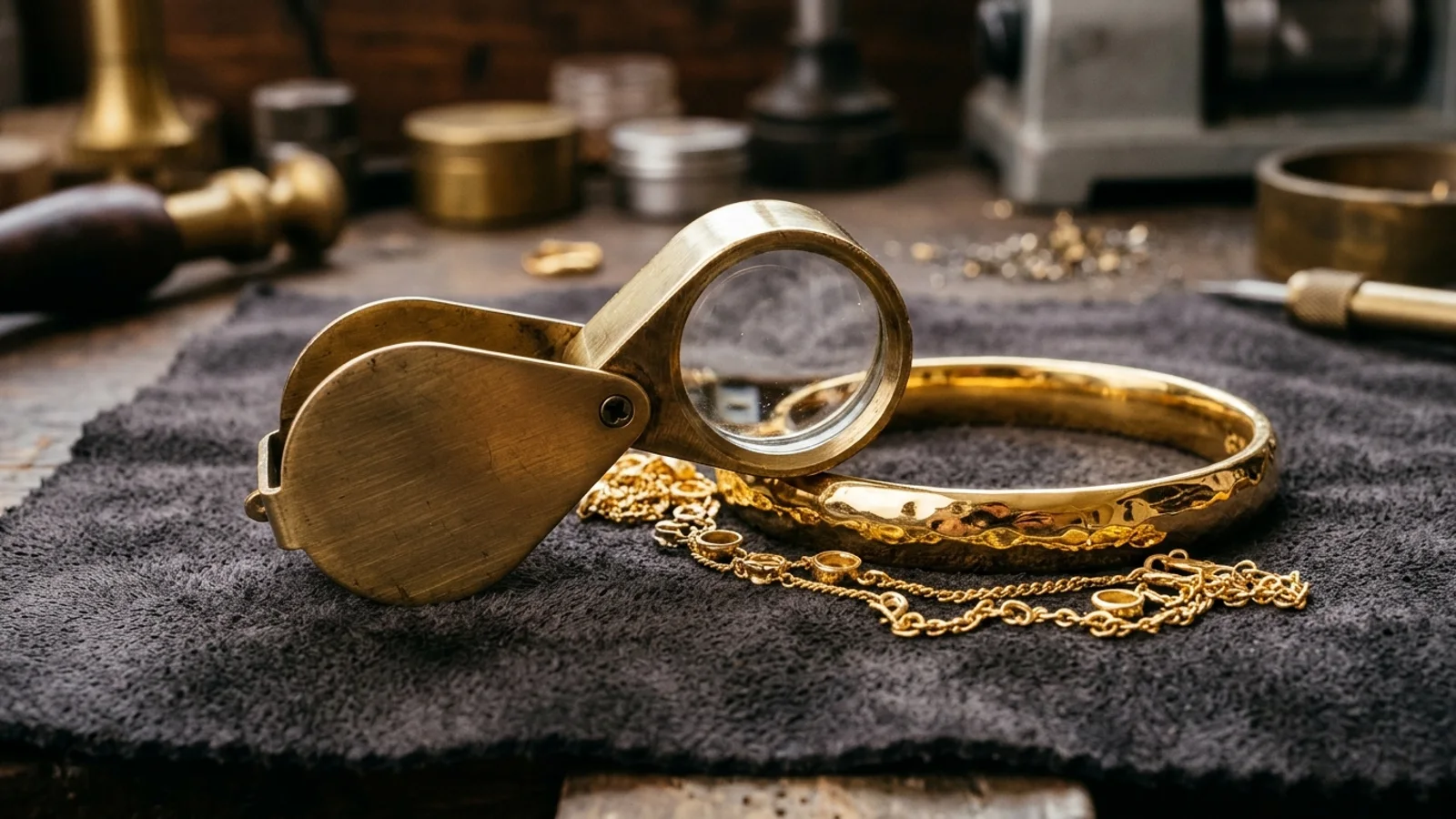
Stage 1: Loupe inspection & decoding tricky stamps
Before touching any testing tool, inspect every hidden surface under bright directional light with a 10x jeweler's loupe (or a modern phone macro lens). Makers tuck hallmarks inside ring curves, along flat lobster-clasp tongues, on the small jump-ring connecting chain to clasp, and on earring posts.
Look for three-digit millesimal stamps (999 = 24K, 916 = 22K, 875 = 21K, 750 = 18K, 585 or 583 = 14K, 417 = 10K, 375 = 9K, 333 = 8K) or karat marks (22K, 18KT, 14KP). Remember that 'KP' stands for Karat Plumb (solid gold), while 'GP', 'GEP', 'HGE', 'RGP', 'EP', or 'GF' indicate surface-plated or gold-filled metal.
Stage 2: Rare-earth magnet screening (with two caveats)
Gold, silver, and copper are non-magnetic. Passing a strong N52 neodymium magnet slowly near a chain or ring instantly flags steel- or iron-core counterfeits that snap firmly toward the magnet.
Keep two crucial limitations in mind: first, almost every genuine gold lobster or spring-ring clasp contains a microscopic steel spring inside the latch that will tug slightly — always test the chain links away from the clasp; second, brass and copper fakes are also non-magnetic, so passing a magnet test only eliminates ferrous fakes rather than proving solid gold.
| Test Method | Damages Jewelry? | Cost | Accuracy & Best Use |
|---|---|---|---|
| 10x Loupe Hallmark Check | No | Free – $10 | Fast first screen; verify counterfeit stamps |
| Neodymium Magnet Check | No | $5 | Catches steel/iron fakes; misses brass/copper |
| Water Specific Gravity Test | No | $15 scale | Excellent for unmarked solid stone-free items |
| Tabletop XRF Spectrometer | No (Zero mark) | $0 – $20 | Gold standard for jewelry & exact alloy % |
| Nitric Acid Touchstone Kit | Yes (Scratches) | $25 kit | Use only on scrap gold destined for melting |
Stage 3: Non-destructive Archimedes water-displacement density test
Pure gold is remarkably heavy for its size (19.32 g/cm³ — more than twice as dense as brass at 8.5 g/cm³ or sterling silver at 10.36 g/cm³). For solid, gemstone-free, non-hollow items, measuring specific gravity at home requires only a $15 digital pocket scale (0.01g resolution), a cup of water, and thin thread.
Weigh the dry item in air and note the mass (W_dry). Next, place a cup of room-temperature water on the scale and press Tare so it reads 0.00g. Suspend the gold item by thin thread completely beneath the water surface without touching the cup walls or bottom, and record the scale reading (W_water). Divide W_dry by W_water to obtain exact density in g/cm³.
Stage 4: Why XRF spectrometry beats old-fashioned acid kits
Traditional nitric-acid touchstone kits force you to rub a piece across an abrasive black stone, leaving a visible flat spot on polished rings and failing whenever heavy gold plating covers a brass core unless you file deeply into the jewelry. Acid kits belong strictly to scrap melters — never to wearable heirlooms.
Instead, ask a reputable bullion dealer, jeweler, or certified assay office for a tabletop X-Ray Fluorescence (XRF) scan. XRF aims harmless low-energy X-rays at the surface and displays an exact elemental readout (for example: 91.7% Au, 5.2% Cu, 3.1% Ag) within ten seconds with zero physical contact.
Stage 5: Extra caution for hollow jewelry & heavy bars
Two cases require special awareness: trapped air inside hollow rope chains or puffed bangles lowers water-displacement readings artificially even when the outer shell is genuine 14K or 18K gold; conversely, heavy 1-ounce or 100-gram counterfeit bars filled with tungsten share gold's exact density (~19.25 g/cm³) and require electronic conductivity or ultrasonic testing.
Worked Real-World Math
Running a Specific Gravity Density Test on an Unmarked Bangle
You inherited a heavy, plain, unmarked yellow gold bangle with no stones and want to confirm whether it is 22K gold or plated brass.
- 1.Dry weight on 0.01g scale (W_dry) = 21.24 grams.
- 2.Tare cup of water to 0.00g; suspend bangle underwater on thin thread (W_water) = 1.20 grams.
- 3.Compute Density = 21.24 ÷ 1.20 = 17.70 g/cm³.
- 4.Match against metallurgical range: 22K solid gold measures 17.4–17.9 g/cm³ (brass sits near 8.5 g/cm³).
Bottom line: A 17.70 g/cm³ reading provides powerful non-destructive confirmation of genuine 22K gold without leaving a single mark.
Before You Act
Non-Destructive Gold Verification Sequence
- Inspect clasps, inner shanks, and bails under 10x magnification before assuming an item is unmarked.
- Run a neodymium magnet along the main body links (skipping clasp springs).
- Use our online Specific Gravity Calculator for stone-free solid pieces.
- Confirm high-value pieces with an XRF printout before negotiating a sale.
- Refuse destructive deep filing or acid rubbing on wearable heirloom jewelry.
Put This Into Practice
Try our Interactive Stamp Decoder & Density Tester
Quick Answers
Frequently Asked Questions
Do the bite test, vinegar test, or makeup foundation test actually work?
No — biting gold can crack teeth or dent soft rings, vinegar cannot reliably separate brass from low-karat gold, and makeup streak tests produce constant false positives. Use density and XRF instead.
Can genuine gold jewelry have no hallmark stamp at all?
Yes. Handcrafted antique pieces, rings resized by a jeweler (who cut out the stamped section of the shank), and pre-hallmarking South Asian or Middle Eastern heirlooms are frequently authentic 21K or 22K gold despite having no mark.
How much does an XRF purity scan cost at a jeweler?
Many bullion dealers and BIS hallmark centers perform a quick XRF readout for free when evaluating a trade, or charge a modest $5–$20 flat fee per article for a printed elemental slip.
Why did my solid 14K hollow rope chain score only 9.2 g/cm³ in water?
Hollow links trap microscopic air pockets underwater, increasing buoyancy and artificially lowering the specific gravity result. Water density testing works reliably only on solid, non-hollow metal.
About the Author
Nadia Rahman — Quantitative Market Data & Pricing Methodology Lead
Specializes in spot-to-retail bullion conversion models, traditional South Asian and Middle Eastern weight systems, and transparent consumer pricing calculators.
Read our editorial & fact-checking standards →