
How Counterfeit Gold Bars Fool Basic Tests — And How Professionals Catch Them
Why tungsten-filled counterfeit bullion bars pass magnets, kitchen scales, and even water-displacement checks — and the exact multi-layer physics tests dealers rely on.
Why blister cards and serial numbers are never enough
Gone are the days when fake gold bars looked like obvious brass bricks sold out of suitcases. Today's sophisticated counterfeiters replicate 1-ounce PAMP Lady Fortuna, Perth Mint Kangaroo, and Valcambi blister cards down to convincing fonts, crisp sealing crimps, and genuine-looking serial numbers cloned straight from real bars photographed on auction sites.
While inspecting packaging alignment, spelling, micro-printing, and official authentication apps (such as PAMP Suisse's Veriscan surface-topography scanner) catches amateur copies, professional bullion desks never authenticate a bar by its plastic wrapper alone.
The physics problem: why tungsten is counterfeiters' favorite metal
On brass or copper fakes, verifying a 1-ounce bar is trivial: brass has less than half the density of pure gold (8.5 vs 19.32 g/cm³), so a brass fake weighing 31.10 grams must be more than twice as thick as a real bar — failing digital caliper checks in two seconds.
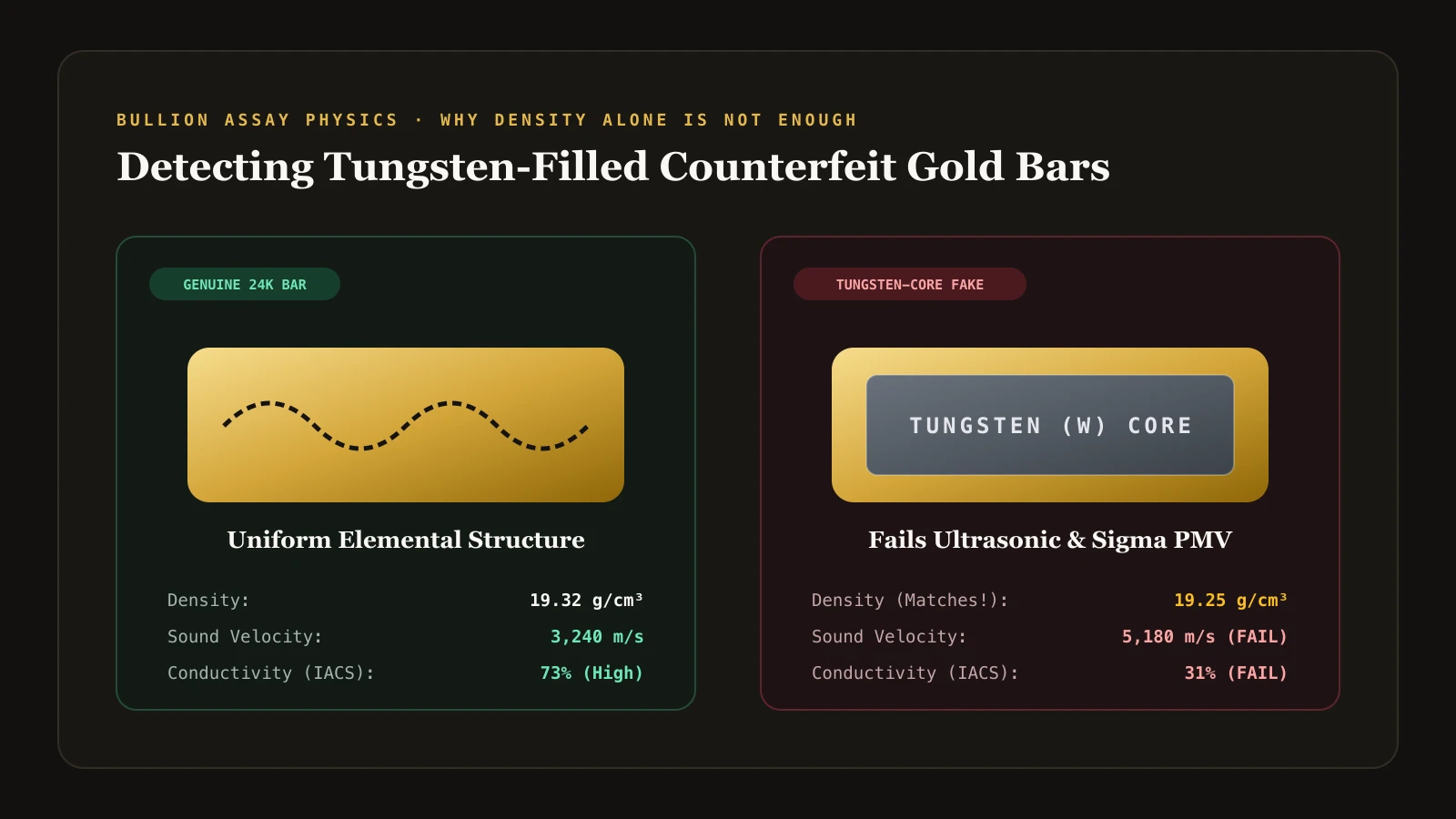
Tungsten breaks that simple shortcut. Pure tungsten has a density of 19.25 g/cm³ — within 0.4% of pure 24K gold (19.32 g/cm³) — while costing a tiny fraction of gold's price. If a counterfeiter machines a tungsten insert and electroplates or clads it in thick 24K gold, the counterfeit matches exact weight (31.10g), exact millimeter dimensions, exact non-magnetic response, exact water density, AND fools shallow acid or surface XRF checks.
| Verification Test | Genuine 24K Bar | Brass / Copper Fake | Gold-Clad Tungsten Fake |
|---|---|---|---|
| Precision Weight (31.10g) | Pass | Pass (if oversized) | Pass |
| Digital Caliper Dimensions | Pass | FAIL (Too thick) | Pass |
| Neodymium Magnet | Pass | Pass | Pass (Slight paramagnetic hint) |
| Water Specific Gravity | 19.32 g/cm³ (Pass) | 8.5 g/cm³ (FAIL) | 19.25 g/cm³ (Fools test!) |
| Surface XRF / Acid | 99.9% Au (Pass) | FAIL if deep | Can fool shallow scan |
| Sigma PMV Conductivity | Pass (~73% IACS) | FAIL | INSTANT FAIL (~31% IACS) |
| Ultrasonic Sound Gauge | Pass (3,240 m/s) | FAIL | INSTANT FAIL (5,180 m/s) |
How professionals catch tungsten cores in two seconds
Nature handed bullion verifiers two decisive physical giveaways: electricity and sound.
1. Electrical conductivity (Eddy-current / Sigma Metalytics PMV): Pure 24K gold is an excellent electrical conductor (~73% IACS), whereas tungsten conducts electricity poorly (~31% IACS — less than half as well). Placing a sealed bar onto an electromagnetic conductivity sensor sends waves deep into the core and immediately flags a tungsten mismatch without breaking the factory assay seal.
2. Ultrasonic sound velocity: Longitudinal sound waves travel through solid 24K gold at ~3,240 meters per second, compared to ~5,180 meters per second through tungsten. An ultrasonic thickness gauge calibrated for gold instantly reports a wildly wrong thickness reading — or detects an internal echo reflection at the gold-tungsten boundary — on heavy 100g or 1kg bars.
Five habits that protect retail buyers completely
First, never buy below-spot 'bargain' gold bars on peer-to-peer marketplaces, social media ads, or unverified auction accounts — genuine bullion dealers never sell 24K bars 15% under global spot. Second, buy from established sovereign mint authorized distributors with clear buyback desks. Third, if purchasing privately on the secondary market, insist on meeting at a local coin dealer who owns a Sigma Metalytics PMV or ultrasonic verifier.
Worked Real-World Math
Verifying a Secondary-Market 1 oz Gold Bar Before Handing Over Cash
A private seller offers a sealed 1-ounce PAMP Suisse bar at spot price ($3,540). Here is the exact 60-second verification routine.
- 1.Scan the bar inside its assay card with PAMP's free Veriscan app to verify microscopic surface topography matches mint archives.
- 2.Measure length, width, and thickness (accounting for blister plastic) against published refinery specs.
- 3.Place the sealed card on a Sigma Metalytics PMV Pro set to '.9999 Pure Gold' — verify the reading lands squarely inside the brackets both front and back.
- 4.Only release wire or cash after all three checks pass cleanly.
Bottom line: A 60-second conductivity scan eliminates the #1 sophisticated counterfeit risk in modern physical bullion.
Before You Act
Counterfeit-Proof Bullion Buying Checklist
- Walk away instantly from any online listing offering 24K bars noticeably below live spot price.
- Purchase from national authorized bullion dealers or sovereign mint partners.
- Prefer coins with optical security features (Maple Leaf radial lines, Britannia latent hologram) if buying without electronic test gear.
- For private trades on 1 oz+ bars, always verify on an electromagnetic conductivity (Sigma) or ultrasonic tester.
Put This Into Practice
Explore all purity tests in our Karat & Verification Guide
Quick Answers
Frequently Asked Questions
Do I have to cut open a sealed PAMP or Perth Mint assay card to test for tungsten?
No. Electromagnetic conductivity verifiers (like Sigma Metalytics PMV) penetrate plastic blister cards cleanly and verify the core metal without opening or damaging the factory seal.
Are tungsten counterfeits common in tiny 1-gram or 5-gram gold bars?
Rarely. Tungsten is extremely brittle and expensive to machine cleanly at tiny thicknesses, so counterfeit 1g–5g wafers are almost always brass or copper and fail caliper and weight checks immediately.
Can a smartphone ping-test app verify gold coins?
Yes, acoustic resonance ('ping') apps work surprisingly well on bare 1-ounce sovereign coins because genuine 24K and 22K coins ring at exact predictable acoustic frequencies that brass or tungsten cannot replicate — though they only work on unencapsulated coins.
What should I do if I suspect a bar I already own might be fake?
Bring it to an established local bullion dealer or coin shop and ask for a non-destructive Sigma PMV and XRF check before attempting to sell it.
About the Author
Daniel Hargrave — Senior Precious Metals Analyst & Managing Editor
Twelve years covering physical bullion markets, retail jewelry hallmarking standards, and retail spread analysis across London, Dubai, Mumbai, and New York.
Read our editorial & fact-checking standards →